BY BJ KILLEEN

2017 Kia Niro Crossover Hybrid: A Smart Choice
While hybrid vehicles may not yet be profitable for automotive manufacturers, it’s a solid option for those looking to save a few bucks on gas and help feel good about being green. Enter the 2017 Kia Niro, which is designed to do just that. We first drove the Niro on the national press launch a few months back, and now we’ve had a chance to spend a week in it during real-world conditions, namely, the arid land of Las Vegas, Nevada.
Kia has announced its five-year “green” roadmap plan, which
includes a 25-percent increase in fuel economy by 2020, a five-percent
reduction in vehicle weight across its lineup, and a commitment to grow its
green-vehicle lineup from four to 11 vehicles by 2020. Which means not only is Niro a big player
here, but in the not-to-distant future this plan also will include a Niro
plug-in hybrid and a fuel cell vehicle somewhere down the line.

The Kia Niro is a compact crossover, bordering on the smaller side. It plays against other vehicles like the Toyota RAV4 EV, and Ford’s C-MAX, as well as the Toyota Prius V, but looks like a real vehicle compared to the Prius.
The Niro is a clean sheet of paper design inside and out. It
does, however, share a platform with the Hyundai Ioniq sedan. The Niro is
smaller than the compact Kia Sportage CUV, and really looks more like a tall
wagon than an SUV. Designed in combination at Kia’s design center in Irvine,
California, and Namyang, Korea, Michael Torpey spearheaded how the Niro would
look.

Torpey’s goal was to make a car that didn’t look like a hybrid, and he did a nice job taking that design idea and turning it into the vehicle you see here. It’s rugged efficiency that features strong shoulders and a purposeful tiger-nose grille, and is contemporary enough as to not blend in with the rest of the segment. The features a coefficient of drag of 0.29, which helps tremendously with fuel efficiency. The whole idea is to be relevant, yet still be different. With the Niro, that mission was achieved.
Inside, the focus is on a relaxing space that’s easy to use.
The Niro’s interior is exactly what the designer envisioned. The instrument
panel is clean and functional, ergonomics are good, the controls are logically
placed, the seats were comfortable, the steering wheel thick and solid, and the
screen easy to read and use. Ingress and egress in the Niro is excellent. Spending
a day in the Niro you appreciate the big things. Spending a week in it, you
appreciate the smaller things, like a comfortable seat for commuting, and
steering wheel controls that are easy to use and intuitive, and lots of cabin
space for people and their things. And by things we mean camera gear, luggage,
and groceries. The cargo features 19.4 cubic feet with all seats up and 54.5
with second-row seats folded including the luggage under tray.
 As we age, we appreciate features like power seats and all
the amenities to make life easier. The leather seats in the Niro Touring were
supportive and comfortable, but we missed a power adjustment option. Other standard
features included dual-zone automatic climate control, USB audio jack, steering-wheel
mounted audio controls, Bluetooth, power windows, cruise control, rearview
camera, and the Drive Mode select system (Eco, Normal, Sport modes).
As we age, we appreciate features like power seats and all
the amenities to make life easier. The leather seats in the Niro Touring were
supportive and comfortable, but we missed a power adjustment option. Other standard
features included dual-zone automatic climate control, USB audio jack, steering-wheel
mounted audio controls, Bluetooth, power windows, cruise control, rearview
camera, and the Drive Mode select system (Eco, Normal, Sport modes).  We always love and appreciate the Harman/ Kardon audio system,
which is standard in Touring models. It features eight speakers, including a
subwoofer, and a center front channel to fill out the sound. It’s 315 watts of great
sound, and includes Clari-Fi technology, which is all about filling in the dead
spots that happen when an MP3 file gets compressed to go digital.
We always love and appreciate the Harman/ Kardon audio system,
which is standard in Touring models. It features eight speakers, including a
subwoofer, and a center front channel to fill out the sound. It’s 315 watts of great
sound, and includes Clari-Fi technology, which is all about filling in the dead
spots that happen when an MP3 file gets compressed to go digital.
Looks are one way to sell a car; efficiency in a hybrid is
another. The Kia Niro’s power is both an Atkinson-cycle four-cylinder 1.6-liter
GDI engine that makes 104 horsepower and 109 lb-ft of torque, combined with an AC
synchronous permanent magnet motor with 43 hp and 125 lb-ft of torque. Total
combined performance for the Niro is 139 horsepower and 195 lb-ft of torque.
While the engine is noisy (honestly, what four cylinders
aren’t?), once you get going in pure EV mode, the silence is deafening.
 For EV power, the Niro uses a 1.56 kWh lithium-ion battery,
and keeps its charge through regenerative braking and recharging from the
engine. It all works seamlessly to allow the Niro to start up and idle in electric
mode, and use the engine to both deliver power to the wheels and recharge the
battery. It’s a simple parallel design that delivers power when and where it’s
needed.
For EV power, the Niro uses a 1.56 kWh lithium-ion battery,
and keeps its charge through regenerative braking and recharging from the
engine. It all works seamlessly to allow the Niro to start up and idle in electric
mode, and use the engine to both deliver power to the wheels and recharge the
battery. It’s a simple parallel design that delivers power when and where it’s
needed.
How it gets that power to the wheels is via an all-new
six-speed dual-clutch transmission, which is a huge and much welcomed departure
from the normal hybrid/CVT combination. The transmission also has a sport mode
to enhance the driving experience. With this powertrain setup, the Touring has
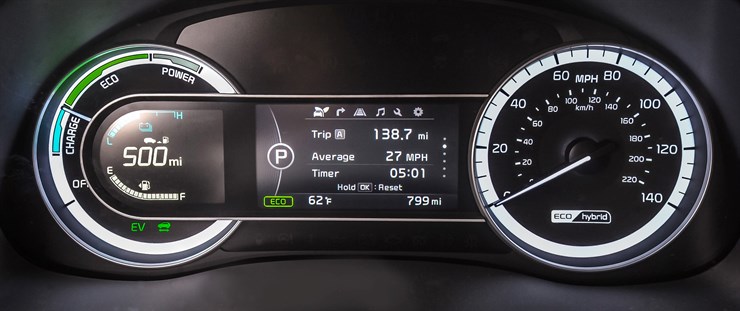
a 46/40/43 EPA estimated fuel economy range. We drove the Niro both hard and
soft, meaning real-world damn-the-torpedoes fuel economy hard, and got about 35
mpg. Driving it soft, as in as much EV time as we could manage, we got about 45
mpg. The Niro doesn’t mind being driven either way. It’s civilized,
comfortable, and a good road or errand-running companion.
The independent MacPherson strut front suspension and
multilink rear setup delivers a comfortable ride that’s also sporty when
pushed. Part of the reason why the Niro handles so well is because of its
structural rigidity. Over 50 percent of the body is made up of advanced
high-strength steel, which adds integrity as well as helps to reduce overall
weight. Using industrial joint adhesives also aids metal bonding without extra
metal welding. With extensive use of aluminum for the hood, tailgate,
suspension and brake components, the Niro is strong yet not overly heavy. Saving
weight in many areas allowed Kia to add extensive insulation and an acoustic
windshield to dampen noise from entering the cabin. And Quad-mount front
subframe bushings also help add strength while maintaining quiet. Once on the
highway, and not putting full load on the engine, the Niro was relatively
scream free. While we aren’t usually a fan of hybrid steering, in the Niro, it
had nice turn in and good response.
 The Niro also has the first-ever use of Kia’s Eco-DAS
(Driver Assistance System), which uses a coasting guide and predictive energy
control that analyzes the driver’s route (through the nav system) to improve
efficiency. Basically a brake coach for the driver, the coasting guide helps
the driver generate the most power back to the battery. Predictive Energy
Control reads the road and actively manages energy flow for battery charging
and battery power usage. Other driver-assist features include blind spot
detection with cross traffic alert, lane change assist, smart cruise control,
lane departure warning, and automatic emergency braking. Of course, Kia’s UVO3
system comes with standard Android Auto and Apple CarPlay, along with 14 free
services such as geo fencing, curfew alert and parking minder standard. For
those who have Android phones, a wireless charging tray is optional only on the
Touring trim.
The Niro also has the first-ever use of Kia’s Eco-DAS
(Driver Assistance System), which uses a coasting guide and predictive energy
control that analyzes the driver’s route (through the nav system) to improve
efficiency. Basically a brake coach for the driver, the coasting guide helps
the driver generate the most power back to the battery. Predictive Energy
Control reads the road and actively manages energy flow for battery charging
and battery power usage. Other driver-assist features include blind spot
detection with cross traffic alert, lane change assist, smart cruise control,
lane departure warning, and automatic emergency braking. Of course, Kia’s UVO3
system comes with standard Android Auto and Apple CarPlay, along with 14 free
services such as geo fencing, curfew alert and parking minder standard. For
those who have Android phones, a wireless charging tray is optional only on the
Touring trim.  As you might expect with hybrids, you’re going to pay more.
With the Niro, it’s priced in line with almost every other vehicle in the
segment that’s not a hybrid. The Niro lineup starts at $22,890, excluding $895
destination, and our Touring model was $30,675 with destination and the long
list of goodies we mentioned previously. For comparison, the Prius V, which is
the closest to the Niro in ideology, starts at $26,675 and goes above
$34,270. The RAV4 Hybrid starts at
$29,030, and the Ford C-MAX begins at $24,120.
As you might expect with hybrids, you’re going to pay more.
With the Niro, it’s priced in line with almost every other vehicle in the
segment that’s not a hybrid. The Niro lineup starts at $22,890, excluding $895
destination, and our Touring model was $30,675 with destination and the long
list of goodies we mentioned previously. For comparison, the Prius V, which is
the closest to the Niro in ideology, starts at $26,675 and goes above
$34,270. The RAV4 Hybrid starts at
$29,030, and the Ford C-MAX begins at $24,120.
Bottom line, the Niro is a great option in the hybrid
crossover segment. We think Kia is on the right track with its entire vehicle
lineup, and the money you’ll save on fuel costs are worth putting it on the
shopping list.


